|
I've written a lot about the courage of American World War II nurses, but this week I discovered the heroism of a Canadian nurse, and learned the story of her valiant effort to save a friend after a torpedo attack by the Germans. I also discovered how taking a step or two out of my comfort zone can generate courage, and I witnessed an amazing step toward peace and reconciliation. It was quite a week after last week's violence combined with my historical photo research. In ten years as a television news reporter I attended scores of demonstrations. Often when there was a protest, there were protesters protesting the protest. Never once did I see the two sides come together as I did last week at Spokane, Washington's #BlackLivesMatter rally. But that's what's happening in this photo. 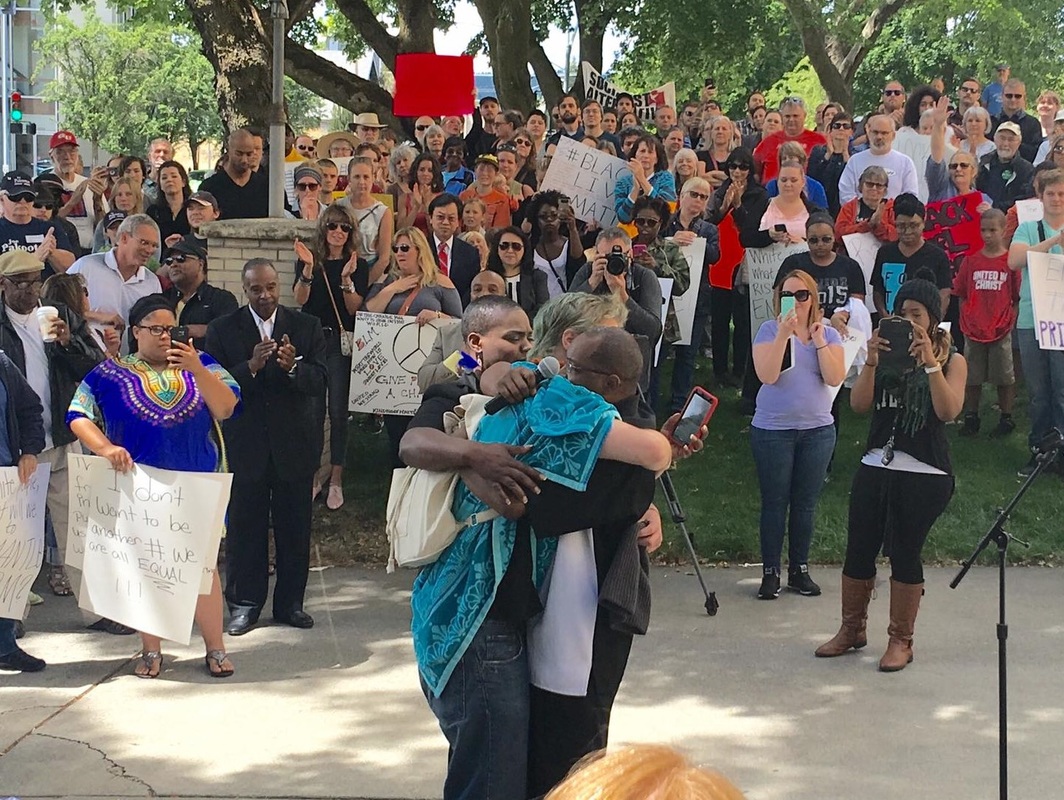 Spokane, Washington, Photo courtesy Daniel Wallace McLay An African American pastor asked the crowd to stop reacting to a heckler, then invited the heckler up for a hug. Later, the head of the local NAACP offered the protester the mic and him speak, while the crowd listened respectfully. Before the end of the rally, those who came to say #BlackLivesMatter, walked to police headquarters and gathered at the memorial for fallen police officers. With a moment of silence and a prayer they demonstrated #BlueLivesMatter, too. 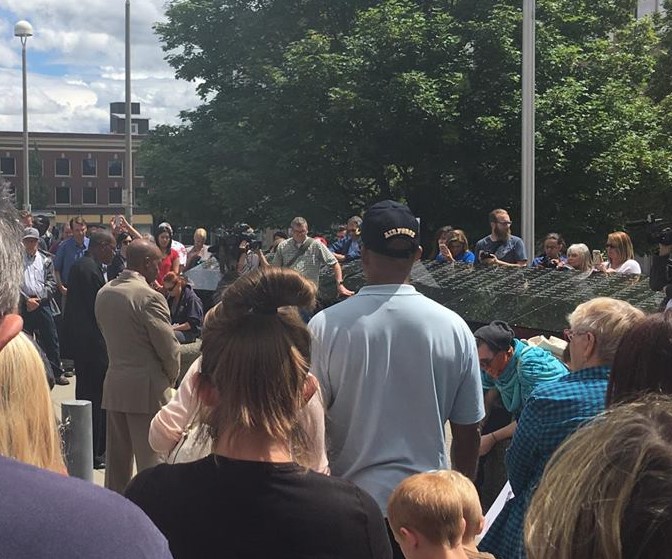 Spokane, Washington, courtesy Daniel Wallace McLay The spirit of the rally moved me. I found myself in tears several times as speakers talked of justice, and of healing divisions, of valuing all lives, of ending violence and working toward understanding. I came away empowered, empowered not to be silent in the face of trouble, but also, not to be strident and not to be judgmental. Opportunity immediately presented itself! Empowered not to be silent in the face of trouble, but also, not to be strident and not to be judgmental. Isn't it funny how that is? This week my personal life offered me the chance to climb down off my high horse, lay down my sword and shield and make the first move toward dialogue. Yes, it was scary. I was afraid I might makes things worse. I was afraid I might get hurt. But at the rally, I had joined the chant silence is consent to the status quo. And I found myself braver than I ever knew I could be. 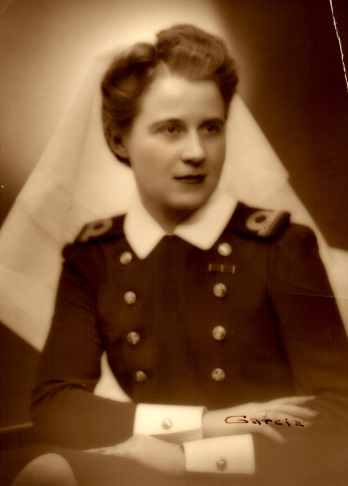 Which brings me to Canadian WWII Nurse Margaret Brooke and the fact that sometimes you can summon your greatest courage and still fail in your task. When the German torpedo slammed against the passenger ferry, the SS Caribou, in the early morning darkness of October 14, 1942, Margaret and Nurse Agnes Wilke were asleep in their bunks. Margaret and Agnes made it to the deck, but their life boat was gone. The ship, crossing Cabot Strait off the coast of Newfoundland, sank in just five minutes, taking the women into the water. "We were just busy staying afloat until an overturned lifeboat came along and the people on that helped us," Margaret said later. They grasped ropes, "and we just hung there."
It would be nearly two hours before rescuers arrived, and before then Agnes' strength collapsed. With one arm Margaret clung tight for her survival, and with the other she held onto her friend. "I held her as long as I could," Margaret says. "I failed. I couldn't hold her any longer." Agnes slipped into the cold depths, one of 137 passengers and crew to die that night. For her selfless act, Margaret Brooke was named a Member of the Order of the British Empire, and the Royal Canadian Navy has named an offshore patrol boat after her. Okay, I'm not saying I'm a hero like Margaret Brooke, far from it. What I'm saying is that whether it's a large step or a small one, when we venture from our comfort zone, we risk failure. And often there's a lot of failure before big change is achieved. But no matter how small, every successful step toward dialogue moves us closer to peace. Small steps also give us hope and strengthen us to take big ones. I've been doing photo research for my upcoming book about African American women in the 1940's, and the racial prejudice they suffered while serving in the United States Army. The lynching of blacks was a fact of life for these women, and though it happened mostly in the south, blacks were lynched in northern states, too. I'd been putting off choosing a photo for this part of the story, but finally had to face the images and they left me depressed for days. Especially after stumbling across a new study that documents the number of lynchings in America is 700 more than previously believed. Titled Lynching in America: Confronting the Legacy of Racial Terror, the report says 3,959 lynchings of African-Americans took place from 1877 to 1950 in states across the South. 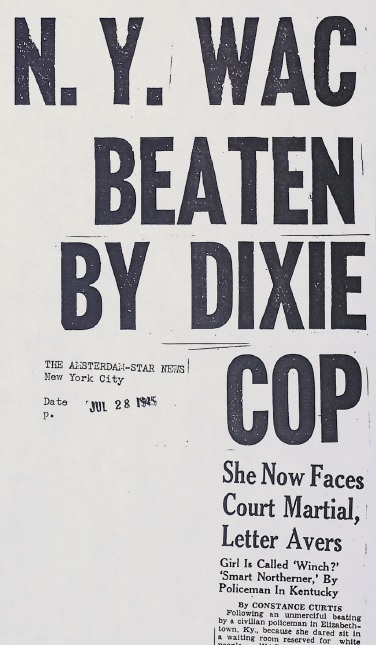 I'll spare you the images, but take a look at this bit of my research. An African American in the Women's Army Corp spent a week in the hospital being beaten by a civilian cop for sitting in white waiting room at the bus station in Elizabethtown, KY. The cop smashed Private Helen Smith over the head with a blackjack, dragged her across the bus station floor and threw her in the town jail. When she was handed over to military police at Fort Knox, she was ordered to face court martial for disorderly conduct and disobeying Kentucky Jim Crow laws. Two other WACs, beaten less severely were similarly charged. The three service women were eventually aquitted when NAACP lawyers argued Kentucky didn't actually have Jim Crow laws written in the books. The civilian cop faced no repercussions in the case. The news of two black men killed by police this week and at least four police officers shot to death overnight has added to my very heavy heart. People have very strong feelings on both sides of this issue, but I wish we could create a safe space to talk about violence in America. 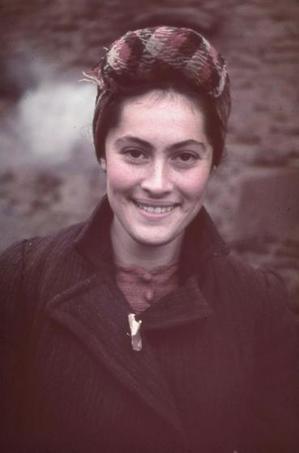 Since writing the adaption of IRENA'S CHILDREN last year, I've been much more tuned into Polish history, and the atrocities Poland suffered under the Nazis. This week I stumbled across some haunting color photographs taken by Adolf Hitler's personal photographer, Hugo Jaeger, in occupied Poland in 1939 and 1940. They are heart-breaking, but I looked at each nameless person and envisioned them beyond the photograph--as flesh and blood, with loved ones, with a life of joys and struggles-- all cut short by the Nazi regime. See the photos here, in a piece called The Brink of Oblivion. Does remembering the victims move us closer to peace? I don't know. But it's something. Click here to check out an interactive database with information
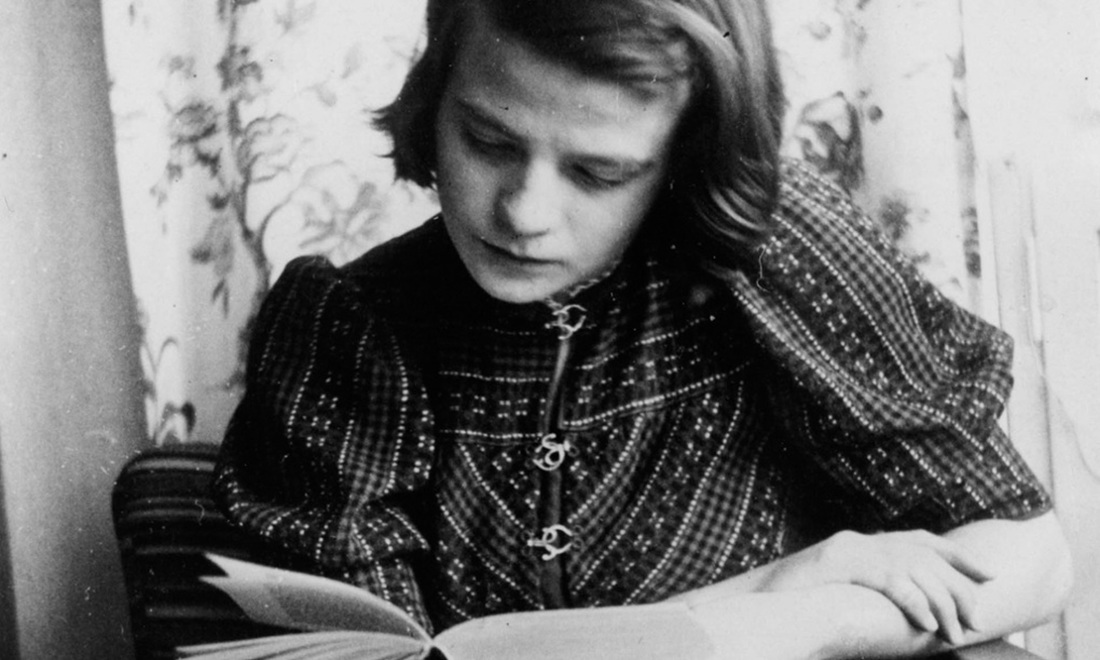
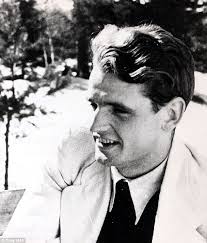
on police killings in the last eighteen months. There's tons of information, and you can decide for yourself what you think. Police have a dangerous job. They are often on calls where they fear for their lives.They are human and vulnerable to mistakes when they have to make split-second decisions. Here you can see the honor roll of law enforcement officers killed this year. Information, talking and listening don't kill anyone. Let's give it a try. I read the The White Rose when I was eleven or twelve years old. Ten days ago, I wouldn’t have been able to tell you the title or name of the protagonist. But then I stumbled upon the story, a story I had not heard in more than 40-years, a story that often came to mind, but blurry in my memory.  I stumbled upon a live wire stretching back to my childhood and the shock and horror of that particular story surged up to the present, as fresh as the day I first felt it. For many, it's The Diary of Anne Frank that brings Nazi Germany up close and personal for the first time. For me, it was The White Rose and Sophie Scholl. Sophie set the standard for courage, both consciously and unconsciously throughout my life. 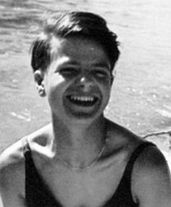 read practically a book a day in my pre- and early-teen years, and I liked nothing more than a chilling adventure story that kept me reading well past my bedtime. The White Rose was such a story, though it was not fiction, as were most books I read. When I reached the last chapter and young Sophie and her brother Hans were executed, I was caught by complete surprise. Nothing in my short life had prepared me for Hitler. The siblings, 21-yr-old Sophie and 24-year-old Hans printed and distributed literature denouncing Hitler and the Nazi government. The pamphlets called on Germans to "cast off the cloak of indifference" and engage in passive resistance to topple the regime. Hans and his friends went out at night and painted slogans on buildings at the university they attended: Hitler the Mass Murderer and Freedom! 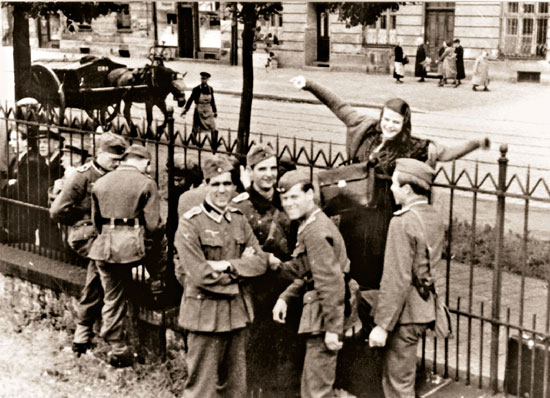 This photo shows the group at the Munich railway station in 1942, the summer before they were arrested and put to death. Sophie is behind the fence, Hans in the center facing the camera, Christoph Probst to the fore, and Alexander Schmorell and Willi Graf to the right. Since I rediscovered Sophie's story in the book Women Heroes of World War II, by Kathryn J. Atwood, I've had a sick-to-my-stomach feeling of fear and dread off and on, as well as finding myself close to tears in unguarded moments. As my childhood experience of this story revisited me, I realized I had often measured myself against Sophie. Holding my whiny self up to her light, I always fell short. Below, Sophie Scholl's mug shots. 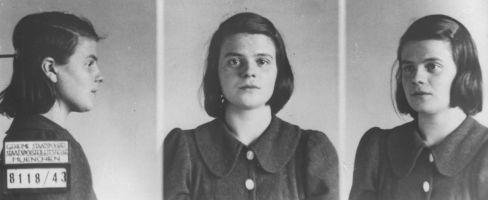 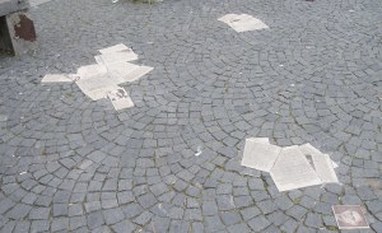 Memorial in Munich Memorial in Munich When I first came across Fannie Sellins’ story, (which is now my forthcoming book) the title of the article was In the Midst of Terror, She Went Out to Her Work. I pursued details as if they were an antidote to my fatal condition. How had Fannie found the courage to go out on the picket line day after day when violent men had threatened to kill her? When I discovered the American military nurses that had been captured POW by the Japanese in WWII, (the subject of Pure Grit) I went on a mad search of the internet for details. I ordered every book I could find that had been written about them. How had these women survived starvation, sickness, isolation for three long years in captivity? How had they kept courage when day 930 in prison camp turned into day 931. As a girl, I could imagine myself bravely printing forbidden pamphlets to protest an unfair government. But I only identified with Sophie to a point. I did not have the courage to risk my life as she did. Sophie’s conviction never left her. She and Hans were executed three hours after their sentencing for treason. The prison guards reported: “They were led off, the girl first, she went without the flicker of an eyelash. None of us understood how this was possible. The executioner said he had never seen anyone meet his end as she did." Sophie told her cell mate the day before her death, "It is such a splendid, sunny day, and I have to go. But how many have to die on the battlefield in these days, how many young promising lives... What does my death matter if by our acts thousands of people are warned and alerted." Today, I am not measuring myself against Sophie's courage. I'm accepting myself for who I am, and I'm freer to see Sophie more clearly, too. When her story is no longer tinged with my self-judgement, I have greater capacity to be inspired by her integrity, to marvel at her valor, and to believe in our human ability to act with virtue in depraved and brutal circumstances. Any thoughts? I'd love to hear from you. Leave your comment below.  As many of you know it's been a rough week saying good-bye to my brother-in-law Javier. When you lose someone you love, you wonder how the world can just go on like it does. The rain still falls, cars go by, people haggle over the last piece of bacon. The gift of grieving is the compassion that comes with the realization that it's not my grief. It's our grief. In every small town and big city, someone's heart is breaking over the loss of a loved one. In every language spoken on earth people cry out in sorrow. Grief is born of love. Can we let our hearts be tender to its touch? 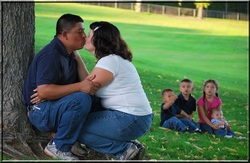 Everyday life is full of contradictions, situations where opposites are true at the same time. Practicing our ability to hold opposing truths builds resilience and lies at the core of a full and healthy life. After Javier's accident and traumatic brain injury, my sister Virginia lived with contradiction for seven-and-a-half weeks. She held hope and belief that her husband would recover, and she knew it was possible he wouldn't survive. Virginia cried in anguish, prayed with faith and she also laughed with joy. The staff at the hospital loved her. (As do we all) They continually spoke of her courage, her warmth, and her commitment to Javier. In between helping with Javier's therapy, she crocheted scarves for other patients! She attuned to joy in the midst of deep sorrow.  The joy of one last time on Daddy's 'dozer The joy of one last time on Daddy's 'dozer Virginia also juggled the contradictions innate between the needs of her husband and the needs of her young children. I love to see her smile and talk about her children. She told me a story about her five-year-old who said, "When Daddy comes home, I'm going to teach him his numbers and colors. Ten plus ten is twenty. Daddy's brain doesn't know that. But mine does." Virginia's practice of holding both joy and sorrow has strengthened her for the days of grief to come. This ability to hold and feel the opposites of joy and sorrow is critical to resilience. To cling only to sorrow, even though sorrow is true, leads to depression and/or bitterness. To cling solely to joy and not acknowledge the depths of pain and loss leads to numbness. Most days, we will not deal with the extremes that Virginia faces. On the periphery of her story, I have practiced being present to her and to my own grief, while at the same time celebrating the launch of PURE GRIT and my joy in work well done. 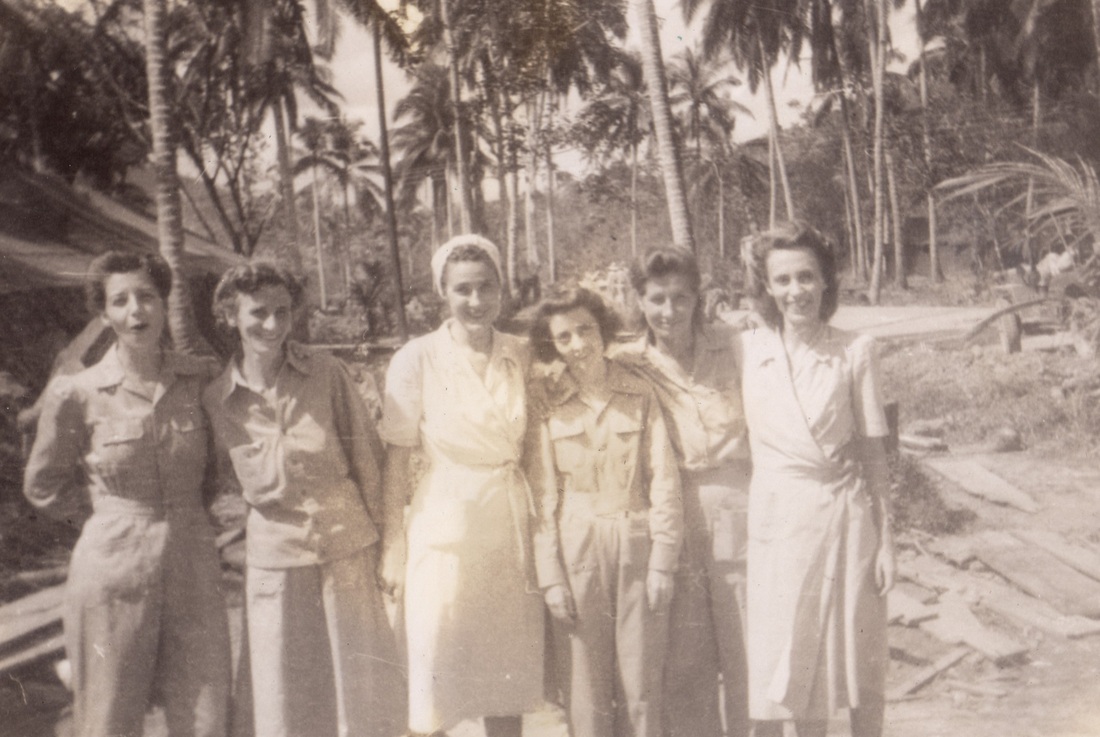 U.S. Army Nurses at 126th General Hospital, Leyte, P.I., February 14, 1945. L to R, Helen Cassini, Anne Wurtz, Alice Zwicker, Letha McHale, Kay Acorn, Rita Palmer. Grasping such contradictions helped the American WWII nurses survive combat and prison camp. In the midst of danger, fear and death, cracking jokes was one way the women stayed centered. For instance, when nurses couldn't bring themselves to eat due to anxiety during the air raids, one joked that if hit, their chances of survival would be better on an empty stomach. After nearly three years in prison camp, the nurses continued to find humor in their situation to help keep their spirits up. Despite the hardships they suffered, the women grasped any excuse to celebrate. Army Nurses Rita Palmer said later, "The birthdays and anniversaries of the members of each one's family far away in the United States or some country were duly feted with a special tablecloth and a cake.” They continued to celebrate when they no longer had ingredients to make a cake. In late 1944, as many as five people were dying each day of starvation related ailments in Santo Tomas Internment Camp. The nurses were as sick as their patients. Army Nurse Frances Nash was so weak, her legs swollen with beriberi that she could hardly walk to the hospital. She wrote in her diary, “We had stood more than I had ever thought the human body and mind could endure.” She also wrote, “There was nothing beautiful in our lives except the sunsets and the moonlight.” Frances saw beauty in the midst of unimaginable suffering. If we open ourselves to what is true moment by moment, we will experience contradiction. Embracing the contradictions builds resilience and invites the fullness of life to flow through us. I'd love to know, what's your experience with these difficult contradictions in life and how we give them their due? 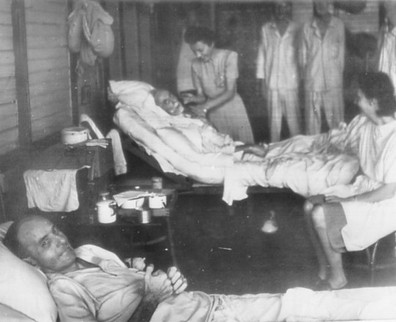 Hospital in Santo Tomas Prison Camp, Manila, P.I. Hospital in Santo Tomas Prison Camp, Manila, P.I. When I started research for PURE GRIT—I wanted to know one thing. How did these women survive combat and prison camp? What kept them going for three long years never knowing if they would see their loved ones again? How did they keep hope alive?
I discovered the different nurses had various ways of keeping their spirits up and coping with the challenges that came on almost a daily basis. But one thing they all had in common was a greater purpose. They were strong, independent, adventurous women, but they were also caregivers. Their mission was to treat the wounded and sick, to save lives if they could and to bestow comfort on the dying. When they were captured POW and separated from the wounded soldiers in their care, they set up a hospital and cared for civilians in the prison camp who needed medical attention. This purpose helped sustain the women. Though weak from hunger and diseased from malnutrition, they got up each morning and reported for duty. Army Nurse Eunice Young wrote in her diary, “Our chief concern is food. People are actually dying of starvation….Haven’t the energy to write much for days…but we have to keep going to take care of the others.” In November 1944, Navy Nurse Edwina Todd wrote that the hospital staff worried because they no long had strength to push the gurney used to move patients. “…carpenters were no longer able to make coffins, the grave-diggers to dig graves, the nurses literally pulled themselves up the stairs…When you bent to rub a patient’s back you wondered if you could straighten up again. You fell down a couple of times en-route to and from work.” Navy Nurse Margaret Nash said, “We kept busy all the time and we didn’t have time to think about ourselves.” I’m not a caregiver type and I doubt I will face the hardship duty these women did. But I have learned from them. They’ve inspired me to give thought to my own purpose. Not just broad overarching ideals like “make the world a better place” or “be loving and kind.” These nurses got down to the nitty-gritty of their mission, dealing with bodily fluids, sores that wouldn’t heal, children that cried and begged for food, and at one point, rats chewing on the dead bodies no one was strong enough to bury. Working on a tough revision pales in comparison. On the other hand, writing well means cultivating difficult habits, like confronting what others shy from. Being still in a world of cacophony. Seeing the brokenness in a human life and letting it touch me. It’s no good comparing another’s purpose. Each of ours will bring enough challenge to last a lifetime. But knowing your particular purpose and believing it is meant for you, will help keep hope alive in the tough times. |
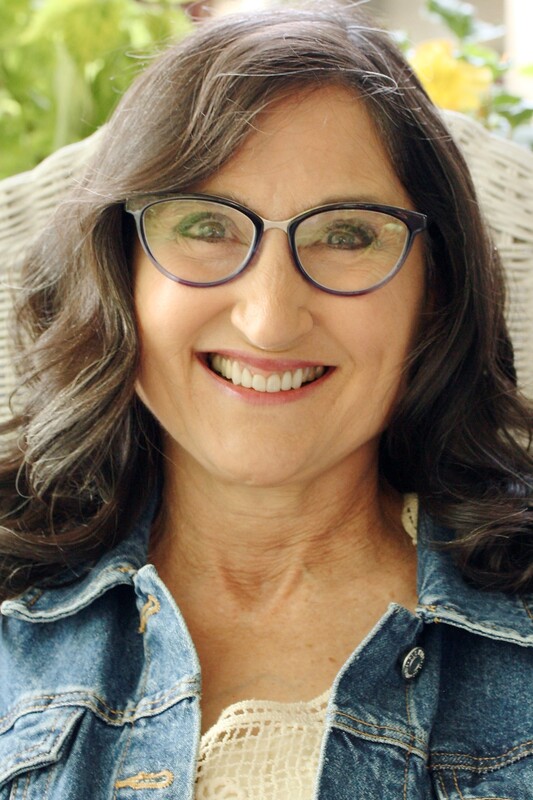
I'm fascinated to discover little-known history, stories of people and events that provide a new perspective on why and how things happened, new voices that haven't been heard, insight into how the past brought us here today, and how it might guide us to a better future.
I also post here about my books and feature other authors and their books on compelling and important historical topics. Occasionally, I share what makes me happy, pictures of my garden, recipes I've made, events I've attended, people I've met. I'm always happy to hear from readers in the blog comments, by email or social media. Archives
September 2023
Categories
All
|